Researchers have developed a robotic material that can synchronize the movement of 37 connected units, turning small vibrations into a coordinated rhythm without an external timing signal.
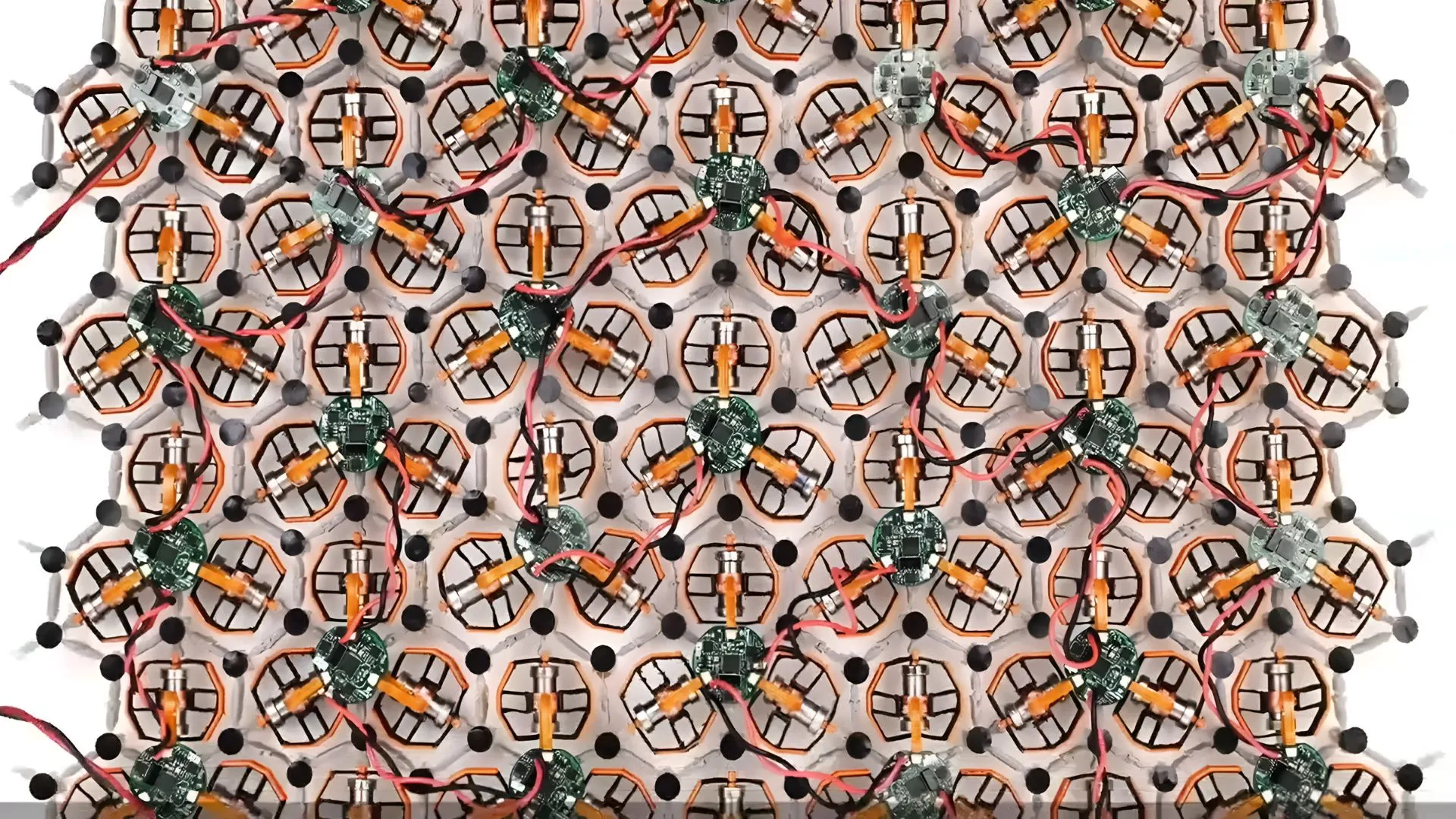
The international team built a two-dimensional honeycomb structure containing 37 active units and a separate elastic ring with 24 motorized units. Both structures developed repeating patterns of movement through interactions between their components.
The researchers describe the behavior as a form of time crystallization, in which a system develops a repeating pattern in time. Unlike conventional crystals, whose atomic structures repeat in space, these experimental materials also display organized movement over time.
The work involved researchers from the universities of Amsterdam, Leiden, Birmingham and other European institutions. It could eventually help engineers develop robotic materials capable of changing shape and coordinating movement without relying on a central controller.
The experimental material combines elastic structures, sensors, electronics and actuators. Actuators convert electrical energy into physical movement, allowing individual components to move and influence their neighbors.
The researchers designed the interactions to be nonreciprocal. This means that when one component influences another, the second does not necessarily produce an equal response in return.
That difference proved important. In the honeycomb structure, individual units initially oscillated at approximately 30 hertz, or 30 times per second. Over time, the vibrations combined into larger patterns, with longer wavelengths and periods, until the structure moved collectively.
” Instead of requiring an external signal to synchronize each component, the system develops an organized rhythm through the interactions built into the material.
Source link