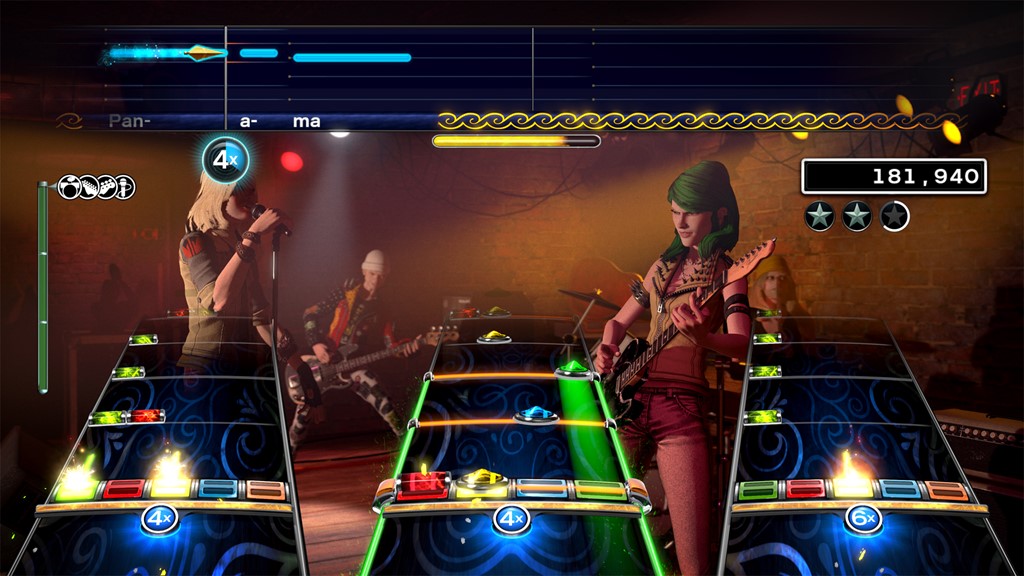
Seeing a Mass Effect: Andromeda recruit jamming on a bass guitar shaped like the Normandy, with a gas-masked Fallout 4 vault dweller on drums, is a time capsule from a very specific moment in video game history. As, indeed, is their stage of choice. Rock Band 4 is the last survivor from a bygone era of plastic-instrument games, their peripherals now mostly consigned to landfills and charity shops, and a gentle introduction to what would become standard live-service practices across the rest of the industry. But it's a time capsule you can still dig up and experience firsthand, Harmonix's coup de grâce still active and receiving support as it approaches the end of its first decade. Given how quickly the genre had moved – and moved on – in the years prior, that's nothing short of a miracle.
By now, it's surely safe to assume you know the drill, if not of this particular game then certainly one of its many predecessors. You pick an instrument, choose a song (one that, in the latter titles, you most likely bought as an add-on), and start playing along by hitting the plastic buttons in time with the onscreen prompt. It's a simple but marvellous concept that was expanded on enormously over a relatively short span. In the Guitar Hero series, the range of instruments quickly grew from just lead guitar to include bass and rhythm. Rock Band added drums and vocals when it launched in 2007, and then keyboard for its third iteration.
Source link