Most people think of the waterfront as the edge of the city. A team of MIT researchers sees it as a dynamic, Lego-like construction site.
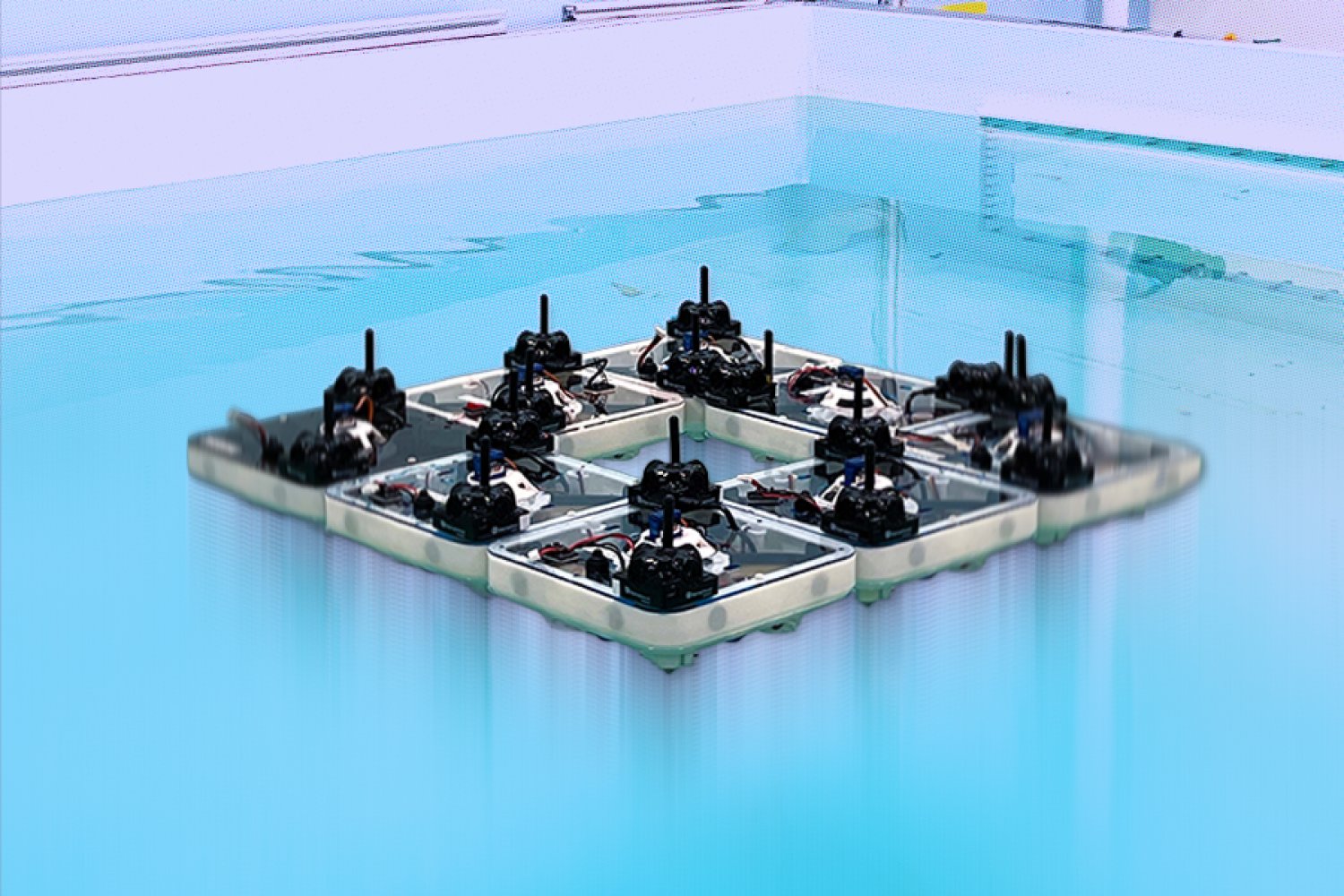
Their new system, called “FloatForm,” is a swarm of small square robotic boats that assemble themselves into larger structures on the water, break apart, and reassemble into something new, all with minimal human direction.
Each robot, about the size of a dinner plate at 21 centimeters square, is a self-contained vessel with its own thrusters, sensors, and magnetic latches. Together, they hint at a future in which floating infrastructure could become more adaptive: a temporary platform after an emergency, a market on a canal, or a stage that appears for a festival and dissolves when the crowd goes home.
“Our FloatForm projects envisions a future where the waterfront becomes a programmable extension of the city, where autonomous boats can self-organize into bridges, platforms, and other useful structures on demand,” says Daniela Rus, the Panasonic Professor of Electrical Engineering and Computer Science at MIT and director of MIT’s Computer Science and Artificial Intelligence Laboratory (CSAIL). “This kind of distributed robotics opens new possibilities for mobility, emergency response, public space, and infrastructure on water.”
“With FloatForm, we are essentially turning static water surfaces into dynamic, programmable spaces,” says Wei Wang, lead author of a new paper on the project and a former MIT research scientist who now leads the Marine Robotics Lab at the University of Wisconsin at Madison.
Source link