
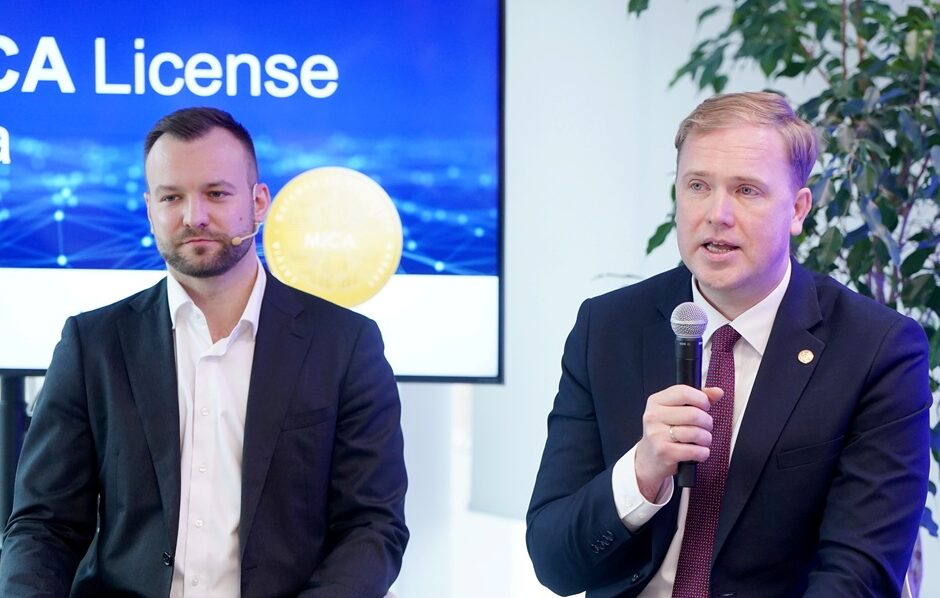
Reinis Znotiņš and Viktors Valainis argue that public-private cooperation has made Latvia a leading MiCA licensing hub, ahead of far larger EU economies.
To date, numerous EU countries, including Poland, Portugal, Romania, Hungary and Greece, have not registered any MiCA-compliant entities. In contrast, Latvia has already issued ten licences, placing it ahead of European economic heavyweights like Spain and Italy, as well as its technologically advanced Nordic neighbours: Sweden, Finland, Norway and Denmark. While Latvia rarely tops European economic rankings, the Web3
industry stands as a remarkable exception: a milestone achieved through close cooperation between the public sector and private industry.
To ensure sustainable national economic growth and escape the middle-income trap, Latvia must demonstrate greater agility, efficiency, and openness to innovation than other countries in the region. This requires a deliberate effort to identify and develop strategic niches within sectors experiencing rapid global growth.
When assessing a nation’s comparative advantages, a pragmatic and rational approach is key. Development of the Web3 and digital financial technology industries in Latvia is backed by several objective and powerful prerequisites.
Latvia’s historically well-developed banking sector and elite higher education programmes (such as the Stockholm School of Economics in Riga and BA School of Business and Finance) have cultivated a highly qualified pool of financial experts. Following the comprehensive “capital repair” of the country’s banking sector, a significant pool of specialised talent became available, allowing Latvia to channel this expertise into new industries. Furthermore, we have successfully established one of the most business-friendly crypto-asset regulatory environments in Europe.
Source link