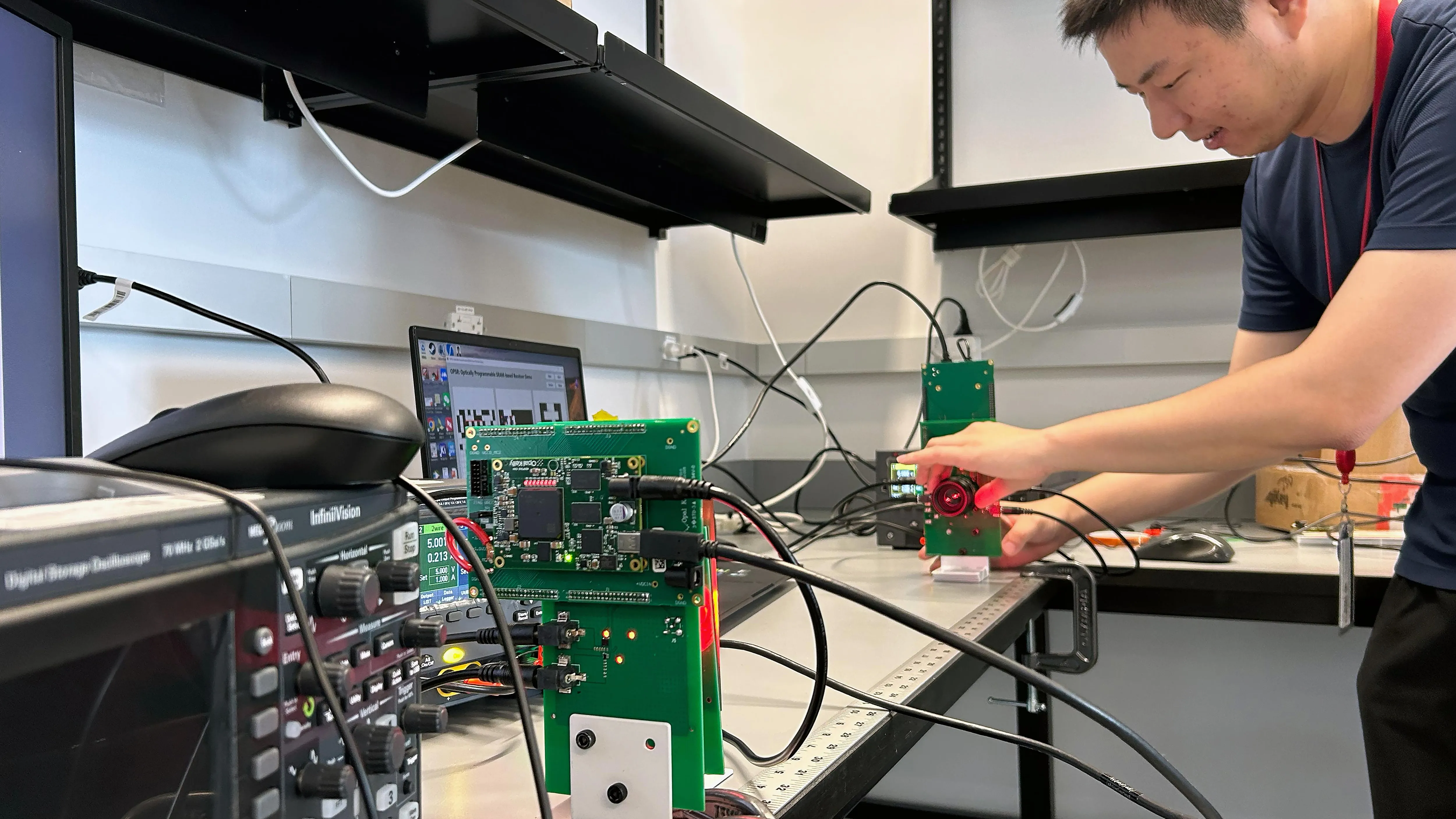
Atop a lab bench, Cornell Tech postdoctoral researcher Yifan He positions the lens of an optical receiver almost a meter away from an LED emitting a beam of red light. The computer monitor attached to the receiver takes a beat to refresh, then displays an array of squares that resemble a QR code.
When you hold your phone camera up to a QR code, light strikes the image sensor as only a first step to revealing the data hidden behind the black-and-white matrix. The receiver here is doing something different: directly altering its own memory using the photocurrents produced by the beamed array of light. And unlike the data behind a QR code, which might point to a simple web address, this optical code could convey the parameters of an AI model.
The new receiver design, presented last month at the IEEE/JSAP Symposium on VLSI Technology & Circuits in Honolulu, seeks to reduce the burden of increasing memory demands on AI systems. Shining data down onto processors could lower the energy typically required for data centers, self-driving cars, and even “edge” applications like AI-powered robots, researchers say.
“People are designing all sorts of different AI chips,” says Jae-sun Seo , an associate professor of electrical and computer engineering at Cornell Tech, in New York City. These processors don’t often have room for all the parameters that make up AI models, so the additional data is stored in dynamic RAM ( DRAM ). The electrical connections commonly used to move the data between the DRAM and the processor create cost and efficiency concerns when systems scale up.
Source link