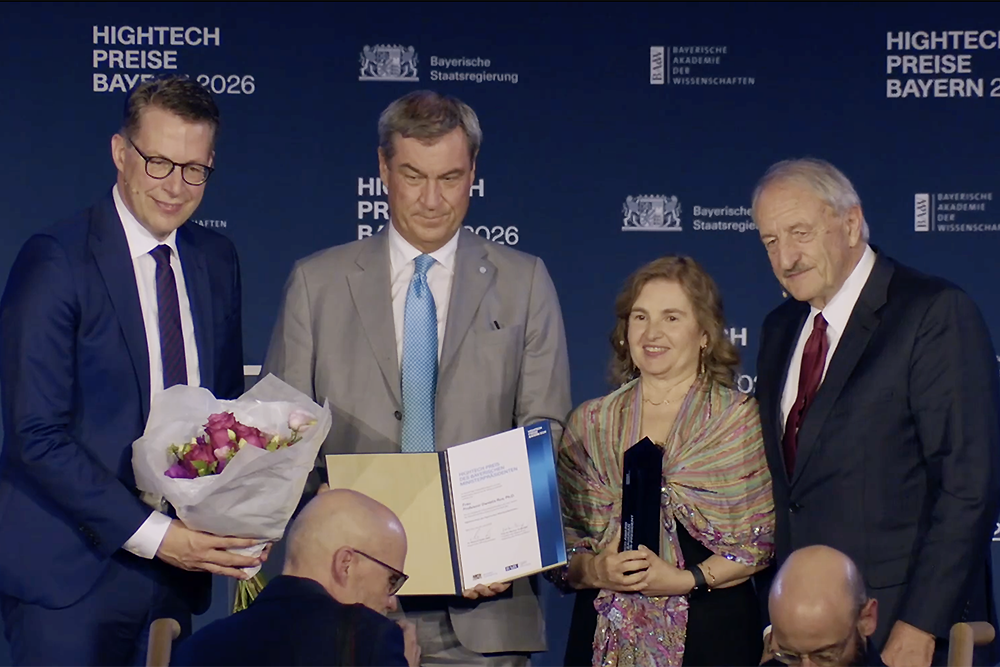
Daniela Rus, director of MIT's Computer Science and Artificial Intelligence Laboratory (CSAIL) and the Panasonic Professor of Computer Science, has received the 2026 High-Tech Prize of the Bavarian Minister-President for her contributions to robotics, artificial intelligence, and autonomous systems.
Awarded jointly by the Bavarian State Government and the Bavarian Academy of Sciences and Humanities, it is the most highly endowed award for technology and engineering in Germany. Rus accepted the prize on July 23 at the Herkulessaal of the Munich Residence.
The selection committee cited four strands of her work: self-organizing robot collectives, soft robotics, autonomous mobility, and brain-inspired artificial intelligence. Together they describe a 30-year effort to build machines that hold up outside the lab, in conditions no one scripted in advance.
That effort has arrived at a moment when physical AI has become a preoccupation for industry leaders and policymakers alike. When human-robot collaboration comes up, the examples tend to be household chores or the factory floor. Rus is working several orders of magnitude wider than that, developing algorithms and systems that put autonomous robots into transportation, agriculture, medicine, the home, and environmental monitoring. She is also a pioneer of soft robotics, where compliant machines manipulate the world more safely and adapt to it more readily than rigid ones can.
Her emphasis throughout has been on giving robots the intelligence to reason and adapt in the real world, through algorithms whose behavior can be explained.
"AI gives machines the ability to do work that humans don't want to do," she says.
Source link