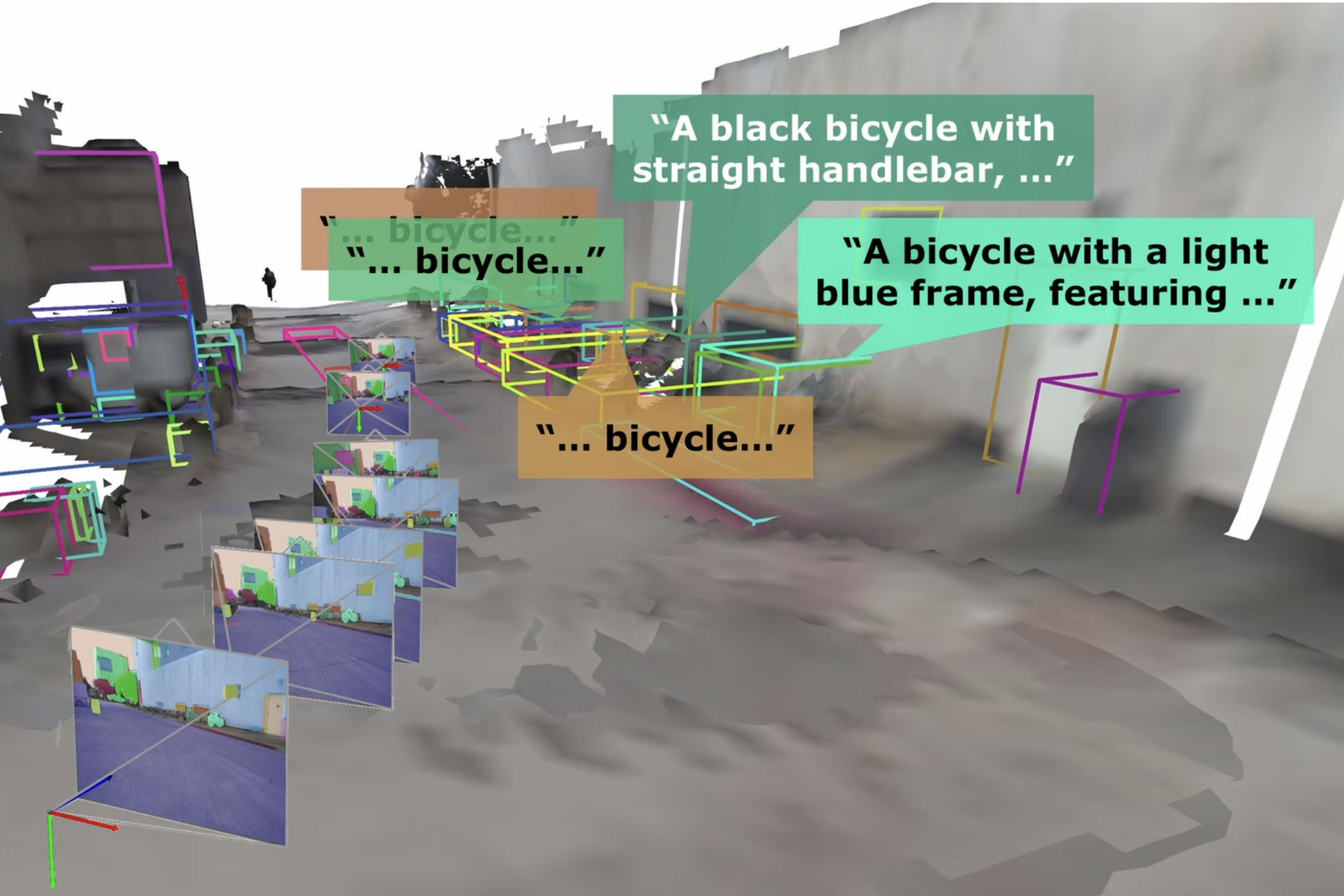
An auto factory worker can remember the storage bin where she left a partly assembled component the night before, and quickly return to that spot to pick it up. But robots that may work side-by-side with her would struggle to develop and access this same type of “spatiotemporal” memory.
Now, MIT researchers have developed a long-term memory framework that allows robots to rapidly form and recall a detailed mental model of complicated, large-scale environments.
In the future, this advance could allow the factory worker to send a robotic assistant to fetch the item, simply by asking it to “go and grab the component we started assembling last night.”
This new method combines advanced map representations with rich descriptions of the environment that the robot gathers as it travels over a long period of time. The robot can quickly access this memory to answer complex queries about its environment in plain language.
This memory framework, which answers questions more accurately than state-of-the-art methods, runs fast enough for a mobile robot to use in real-time.
In addition to its potential uses in robotics, this method could have applications in augmented reality systems that aid maintenance workers in anomaly detection or assist commuters in wayfinding.
“If we want robots to work side-by-side with humans and interact better with humans, they must speak the same language. The robot must be able to reason about time and space the same way humans do. That is essentially what our method is doing. It is turning a traditional map into a language-based map that is easier for the robot to think about and access using language,” says Luca Carlone, an associate professor in MIT’s Department of Aeronautics and Astronautics (AeroAstro), principal investigator in the Laboratory for Information and Decision Systems (LIDS), and director of the MIT SPARK Laboratory.
Source link