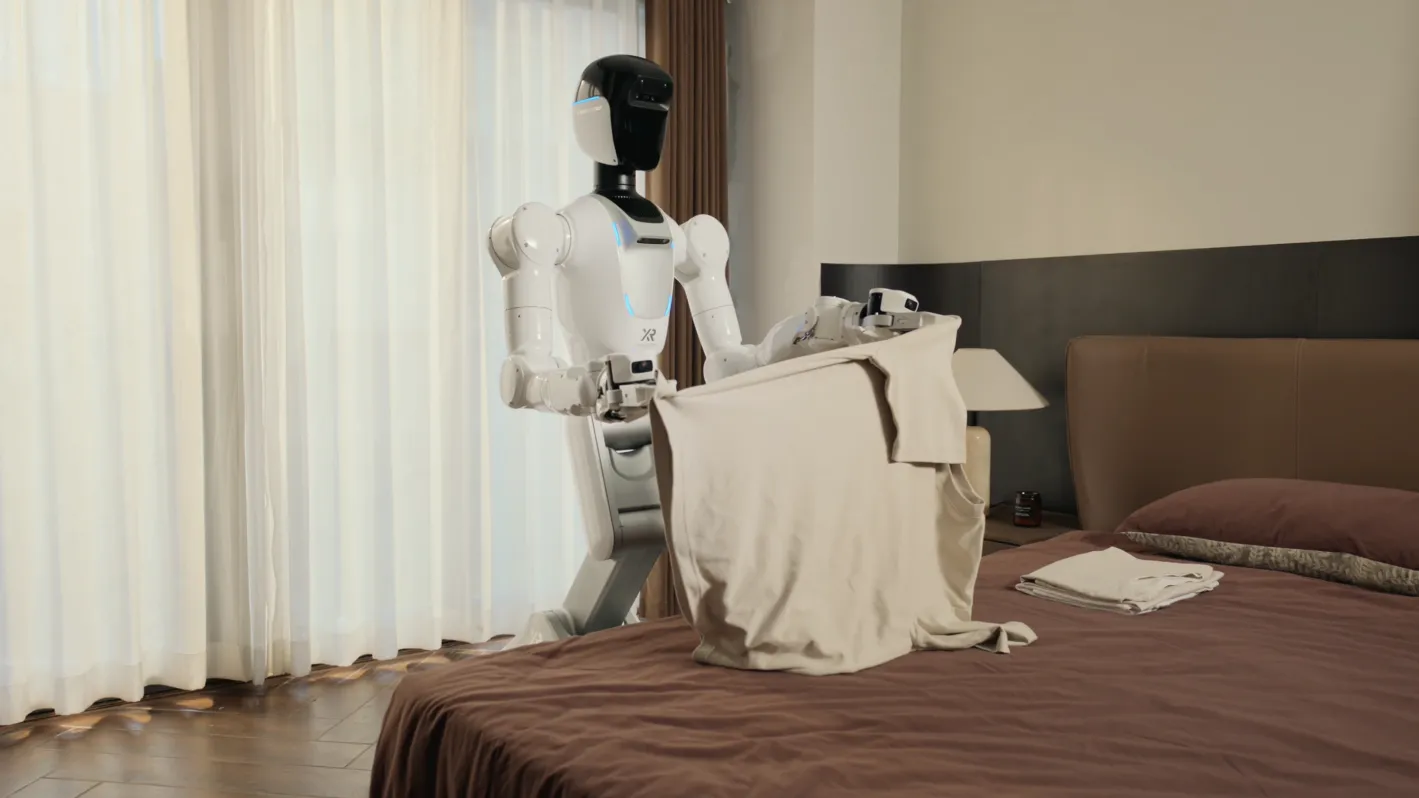
Large language models gave artificial intelligence a working recipe. Pretrain a large model on broad data, and general capability follows. Robotics has no such recipe. Robotics systems have long been assembled from separate perception, planning, and control parts that rarely add up to intelligence a robot can carry from one task to another, or one machine to another. The central problem in embodied AI is to find the equivalent recipe, and the field does not yet agree on what it is.
X Square Robot, a Chinese embodied-AI company, has made an unusually explicit bet. It argues that the recipe is an integrated stack, spanning the data a robot learns from, a world model for predicting changes in the physical world, and an action model that brings together perception, planning, reasoning, and decision-making to generate executable robot behavior. The company also believes that the stack should be built and released in the open.
X Square Robot shares its vision of bringing robots into real homes.X Square Robot
What holds the stack together is a small set of principles rather than a single overarching model.
These principles make the layers interdependent, since the same robot-free data that trains the action model is also structured to feed the world model. It is worth being precise, though. The company describes the world model and the action model as complementary but independent model families that share a code base. Both sit within its broader World Unified Model, which it has presented as an architecture for training vision, language, action, and physical prediction together.
Source link